
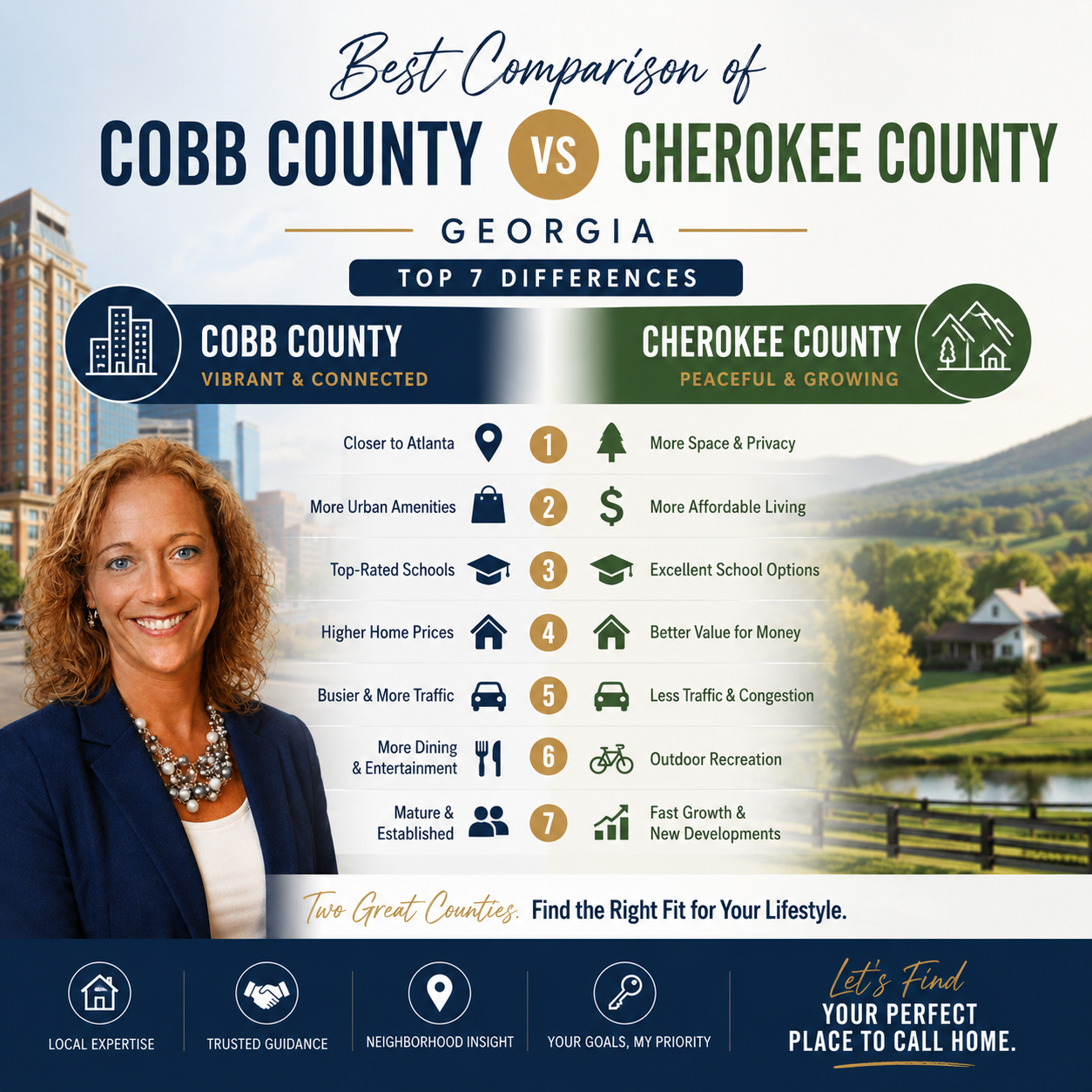
Should you buy in Cobb County or Cherokee County, Georgia?
This is one of the most common decisions buyers face in Northwest Atlanta — and it is one where the right answer depends entirely on factors that a Zillow comparison cannot tell you. Home prices, property tax rates, school districts, commute profiles, development stages, and lifestyle characters all differ meaningfully between these two adjacent counties, and the differences compound over a decade of ownership into outcomes that can vary by tens of thousands of dollars.
Most buyers who are cross-shopping Cobb and Cherokee County are looking at communities that feel similar on the surface — both counties have established master-planned neighborhoods, strong school systems, resort-style amenities, and the kind of suburban character that attracts families, relocators, and move-up buyers from across the Atlanta metro. The differences are in the details. And in real estate, the details determine the outcome.
Cobb County had 1.4% population growth in recent years while Cherokee County is growing significantly faster — Cherokee County is home to a population of 281,000 people, and the median property value in Cherokee County was $435,100 in 2024, up 11.6% from $389,800 in 2023. Those are not incidental statistics. They reflect two counties at different stages of their growth cycles — and buyers who understand what that means for their purchase are better positioned than buyers who are simply comparing price tags.
Nicole France, REALTOR® with RE/MAX Center, has closed transactions in both Cobb County and Cherokee County for over 26 years. Here are the seven differences that matter most to buyers making this decision.
1. Home Prices: Cobb County vs. Cherokee County
Home prices in Cobb County and Cherokee County are more comparable than they were five years ago — but meaningful differences persist depending on which part of each county you’re targeting. Cobb County’s established western corridor — Acworth, Kennesaw, and the Barrett Parkway area — runs from the mid-$300s to over $700,000 for established single-family homes, with the most sought-after communities like Legacy Park, Brookstone, and Governors Towne Club at the upper end of that range. The Cobb County premium reflects the county’s more established commercial infrastructure, its proximity to Atlanta’s employment centers, and the depth of its community character.
The median property value in Cherokee County was $435,100 in 2024, up 11.6% from the prior year. In Cherokee County’s most active markets — Towne Lake and Eagle Watch in Woodstock, Bradshaw Farm in the Hickory Flat corridor, and newer communities along the Canton and Holly Springs corridors — prices overlap significantly with Cobb County’s western communities. The Cherokee County premium exists in the corridor’s most sought-after addresses, while the county’s less-searched corridors — North Cherokee toward Ball Ground and Canton’s outer areas — offer meaningful value relative to comparable Cobb County product.
The practical implication for buyers: at equivalent price points, Cherokee County typically delivers more square footage, more lot size, and newer construction than comparable Cobb County product. Cobb County at the same price point typically delivers better commute positioning to Atlanta’s employment centers and more established commercial infrastructure. The right trade-off depends entirely on your priorities. Find out what your current home is worth before making the county decision.
2. Property Taxes: A Closer Look at the Real Difference
The property tax comparison between Cobb County and Cherokee County is one of the most nuanced and most misunderstood aspects of this decision — because the effective rates are surprisingly similar despite what buyers often assume. The effective property tax rate in both Cobb County and Cherokee County is 0.68% — meaning that on a $450,000 home, the annual tax bill is approximately $3,060 in both counties before exemptions and adjustments. The similarity in effective rates surprises buyers who assume Cherokee County is significantly cheaper on taxes than Cobb.
The difference becomes meaningful when exemptions are applied. Cherokee County offers a double homestead exemption for eligible older homeowners, reducing the assessed value of a home by $5,000 for county taxes and $200,400 for school taxes. For qualifying buyers 65 and older, that Cherokee County school tax exemption produces annual savings of $2,000 or more compared to a comparable Cobb County property — a significant long-term advantage for buyers who are planning for a multi-decade retirement in their next home. Cobb County has its own senior exemptions, including a school tax exemption for qualifying residents 62 and older — confirm current requirements and amounts directly with each county’s tax commissioner’s office before factoring any specific exemption into your budget.
The more meaningful tax comparison between the two counties for most buyers is not the rate — it is the total assessed value trajectory. Cherokee County’s faster appreciation means assessed values are rising faster, which produces faster-rising tax bills even at a stable millage rate. Buyers who are budget-sensitive over a long hold period should factor the appreciation rate differential into their tax cost projection, not just the current effective rate.
3. School Districts: Both Strong, Different in Character
Both Cobb County and Cherokee County operate top-performing school districts — this is not a decision where one county clearly wins and the other clearly loses. The distinction is in the character of the systems, the specific schools serving specific addresses, and the specialized programming available at each.
The Cobb County School District is one of the largest school systems in Georgia, serving over 110,000 students across more than 100 schools. Its scale produces both breadth — a wide range of magnet programs, career academies, and specialized schools — and the complexity that comes with managing a system of that size. Cobb County’s high schools in the Kennesaw and Acworth corridors — Kennesaw Mountain High School, North Cobb High School, Harrison High School — are consistently rated among the stronger high schools in Cobb County and in the broader Atlanta metro.
The Cherokee County School District is smaller, serving approximately 43,000 students across 35 schools, which produces a more cohesive district culture and a community scale where individual schools have more distinct identities. Cherokee County households had a median income of $108,115 in 2024, slightly higher than Cobb County households at $102,738 — reflecting a community demographic that tends to produce high levels of parent engagement and strong school programming. Creekview High School in North Cherokee County is recognized for its academic programs. Woodstock High School draws strong community support.
For buyers who are targeting a specific school — an elementary with a particular program, a high school with a specific athletic or academic track — the county-level comparison is less useful than the address-level school assignment confirmation. Both counties have strong schools and schools that are less strong. Confirm the specific school assignment for any address you’re seriously considering before making a decision based on county-level school generalizations. Nicole France can confirm school assignments for any specific address in either county.
4. Commute to Atlanta: Closer but Cobb, Growing but Cherokee
This is the most practically significant difference for buyers who commute to Atlanta’s employment centers, and it is one where Cobb County has a structural advantage that will persist regardless of how Cherokee County grows. Cobb County’s western corridor — Acworth along I-75, Kennesaw along I-575 — sits closer to Atlanta’s core employment centers than Cherokee County’s primary markets in Woodstock and Canton. The distance difference is roughly 8 to 12 miles, which in Metro Atlanta traffic translates to 15 to 25 minutes of additional commute time during peak hours.
People in Cherokee County have an average commute time of 31.3 minutes — but that average includes a large remote worker population and off-peak commuters who flatten the number. Buyers commuting to Midtown or Buckhead from Woodstock should plan for 45 to 65 minutes during peak hours. Buyers making the same commute from Acworth or Kennesaw should plan for 35 to 55 minutes — a real difference that accumulates over years of daily driving.
The I-575 Express Lanes from Woodstock partially close this gap for Cherokee County buyers who are willing to pay the variable toll for a managed travel time. For buyers with hybrid schedules or employer locations in the northwest Atlanta corridor — Kennesaw, Marietta, the Cumberland business district — the commute differential between Cobb and Cherokee County narrows significantly. The right calculation depends on your specific employer location, your commute frequency, and your tolerance for variable peak-hour travel times. Drive both routes at your actual commute time before you make this decision.
5. Development Stage and Commercial Infrastructure
Cobb County’s western corridor is a fully mature suburban market. The commercial infrastructure along Barrett Parkway, the Town Center at Cobb corridor, and the Kennesaw and Acworth retail nodes has been building for 30-plus years — producing the kind of fully built-out commercial environment where every major retailer, restaurant category, medical network, and service provider is represented within a short drive of any residential address. Buyers who move to Cobb County’s western corridor are buying into a market where the commercial convenience is already there.
Cherokee County is a growing market with a strong but still-developing commercial infrastructure. Downtown Woodstock’s Main Street is exceptional. The Towne Lake Parkway corridor has significant retail and dining. Northside Hospital Cherokee in Canton is expanding. But the depth of specialist medical services, the range of specialty retail, and the density of dining options in Cherokee County’s less-established corridors does not yet match what Cobb County’s mature commercial nodes deliver. North Cherokee, particularly around Ball Ground, is seeing an influx of move-up buyers from South Cherokee and Forsyth seeking larger lots without the Forsyth price tag — but the commercial build-out in North Cherokee still lags the residential growth.
The implication for buyers: Cobb County buyers are buying convenience. Cherokee County buyers are buying growth. Buyers who are comfortable with commercial infrastructure that is still developing — and who value the appreciation potential that comes with buying ahead of that development — are well-positioned in Cherokee County. Buyers who want everything already in place and don’t want to wait for the retail and dining landscape to catch up are better served in Cobb County’s established western corridor.
6. Growth Trajectory and Long-Term Appreciation
This is where the comparison tilts meaningfully in Cherokee County’s favor for buyers who are evaluating their purchase as a long-term investment alongside a lifestyle decision. Cherokee County’s population is projected to grow significantly through 2050, while Cobb County had just 1.4% population growth in recent years — reflecting two counties at very different stages of their growth curves. Cobb County’s western corridor is a mature market with modest appreciation driven by general inflation and sustained demand from a large existing population. Cherokee County is a growth market with structural demand from continued in-migration, corporate expansion, and the sustained population growth that has characterized the county for 24 consecutive years.
Buyers who purchased in Woodstock’s Towne Lake corridor or Eagle Watch a decade ago have seen their investment appreciate in ways that meaningfully outperformed the broader Atlanta metro average. That appreciation trajectory is supported by the same fundamentals today — population growth, corporate expansion (Becker Robotic Equipment’s new $30 million North American headquarters in Canton), healthcare investment (Northside Hospital Cherokee expansion), and the continued in-migration of buyers from higher-cost markets who are specifically targeting Cherokee County. Cobb County’s western corridor offers stability and proven value. Cherokee County offers growth and the appreciation that follows from buying into a county that has been growing every year for a quarter century and shows no signs of stopping.
7. Lifestyle Character: Established vs. Emerging
The lifestyle difference between Cobb County’s western corridor and Cherokee County is perhaps the most subjective but also the most immediately felt by buyers who visit both. Cobb County’s Acworth and Kennesaw are established suburban cities with the settled character, mature tree canopy, well-worn community culture, and commercial variety that comes from 30-plus years of sustained development. The neighborhoods feel rooted. The community events have decades of tradition. The streets have the specific quality of a place that has been lived in for a long time.
Cherokee County’s Woodstock and Canton are a different kind of energy. The downtown is newer and more actively growing. The community events are building momentum rather than drawing on tradition. The neighborhoods in the Towne Lake corridor feel newer and more designed. That energy is genuinely appealing to buyers who want to be part of something that is becoming rather than something that has arrived — and who see the value in getting in before the full maturation of a market that is clearly moving in a strong direction.
Neither lifestyle character is superior. They serve different buyer profiles and different life stages. The buyer who wants the settled, everything-in-place quality of a mature suburban market is better served in Cobb County’s western corridor. The buyer who wants to be part of a city that is actively investing in its downtown, expanding its healthcare infrastructure, and building the community character that will define it for the next generation is better positioned in Cherokee County. Knowing which one you are is the most important self-knowledge you can bring to this decision. Explore all of Nicole’s service areas in both counties on the areas we serve page.
Frequently Asked Questions: Cobb County vs. Cherokee County, Georgia
Is Cobb County or Cherokee County better for families?
Both counties are consistently rated among the best in Georgia for family living. Cobb County’s advantage is its established school district with a wider range of specialized programs and its more mature commercial infrastructure that provides convenience for busy families. Cherokee County’s advantage is its stronger long-term growth trajectory, its newer community infrastructure in developments like Great Sky and Towne Lake, and its higher homeownership rate. Cherokee County’s homeownership rate is 77.3%, significantly higher than the national average of 65.2% — a statistic that reflects the strong, owner-occupied community character that families specifically value. The right county for your family depends on your specific school priorities, commute destination, and lifestyle preferences.
Are property taxes higher in Cobb County or Cherokee County?
The effective property tax rates in Cobb County and Cherokee County are approximately equal at 0.68% of assessed home value. The practical difference at current home price levels is modest — within a few hundred dollars per year at median home values. The more meaningful difference is in senior exemptions: Cherokee County’s double homestead exemption for eligible older homeowners produces more significant school tax savings than comparable Cobb County exemptions for qualifying buyers. Confirm current exemption requirements and amounts with each county’s tax commissioner’s office before factoring any specific exemption into your budget.
Which county is growing faster — Cobb or Cherokee?
Cherokee County is growing significantly faster. Cobb County had 1.4% population growth in recent years, while Cherokee County has been growing at a rate that has produced 24 consecutive years of population increases. Cherokee County’s population is projected to grow significantly through 2050, supported by continued in-migration from higher-cost markets, corporate expansion in the Canton corridor, and the healthcare infrastructure investment of Northside Hospital Cherokee’s expansion. For buyers who are evaluating their purchase partly as a long-term investment, Cherokee County’s growth trajectory supports a stronger appreciation case over a multi-decade ownership horizon.
Ready to Choose Between Cobb County and Cherokee County?
Nicole France, REALTOR® with RE/MAX Center, has been helping buyers make the Cobb County versus Cherokee County decision for over 26 years. She knows the specific communities, school assignments, tax structures, commute profiles, and lifestyle characters of both counties in detail — and she can help you match your specific priorities to the county and community that actually fits.
Schedule a complimentary and confidential consultation with Nicole France at (404) 867-3869 or visit nicolefrance-realestate.com to start the comparison before you schedule your first showing.
Nicole France is a REALTOR® with RE/MAX Center serving buyers and sellers across Acworth, Kennesaw, Dallas, Cartersville, and Woodstock. Client Focused · Results Driven.