
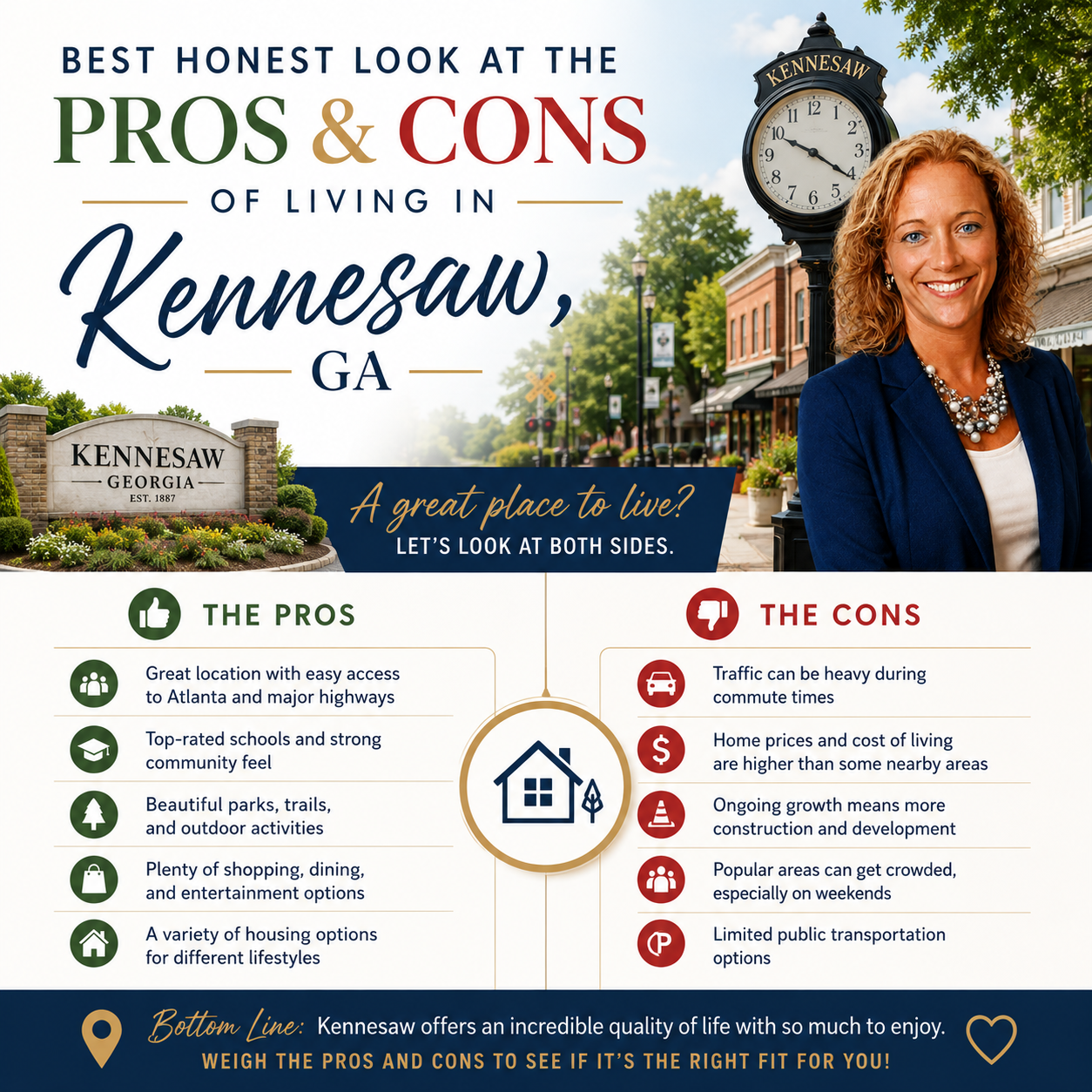
What are the real pros and cons of living in Kennesaw, GA?
Kennesaw is one of the most consistently recommended suburbs in Northwest Atlanta — and like every city worth taking seriously, it comes with real trade-offs that buyers deserve to know before they commit.
Kennesaw has been earning recognition for years. Kennesaw is in Cobb County and is one of the best places to live in Georgia. The city offers something genuinely rare in the suburban Atlanta market: a combination of Kennesaw Mountain National Battlefield Park’s 22-plus miles of trails at the front door, a Cobb County School District that consistently outperforms state averages, a downtown that is actively investing in its character and entertainment infrastructure, a major university that drives economic diversity and cultural energy, and an established residential market with neighborhood variety across price points from the mid-$300s to over $700,000.
But Kennesaw is not the right fit for every buyer. The housing costs sit above both Georgia and national averages. Traffic on I-75 during peak hours is a genuine daily variable. The city is car-dependent, with no meaningful public transit. The limited nightlife means buyers who want an active late-night social scene will find themselves driving to Atlanta. And the HOA culture in some Kennesaw communities is strict enough to feel constraining for buyers who are accustomed to more personal freedom over their property’s appearance.
The buyers who love Kennesaw are the ones who went in with clear eyes. They understood the commute before they bought. They chose the right neighborhood for their lifestyle. And they made a deliberate decision based on the full picture — not just the headline. Nicole France, REALTOR® with RE/MAX Center, has worked the Kennesaw market for over 26 years. Here is the honest version.
Pro #1: Kennesaw Mountain — Trail Access in Your Daily Routine
Kennesaw Mountain National Battlefield Park is the most significant quality-of-life differentiator that Kennesaw offers over comparable suburban markets — and it is one that buyers consistently undervalue until they’ve lived here and experienced what it actually means to have 22-plus miles of interconnected trails within minutes of home. The park covers 2,965 acres of preserved Civil War battlefield terrain, with a summit trail that climbs 600 feet of elevation gain to ridge-top views of Atlanta’s skyline and the Blue Ridge foothills simultaneously. The Burnt Hickory corridor, the Noses Creek section, and the Little Kennesaw Mountain trails extend the system into a genuine multi-day exploration opportunity for residents who use it regularly.
What makes Kennesaw Mountain specifically valuable is the daily accessibility. This is not a weekend destination that requires a 90-minute drive. It is a Tuesday morning trail run before work, a Sunday afternoon family hike, a Thursday evening walk after dinner. The park is free, open daily from dawn to dusk, and dog-friendly. Residents of Legacy Park, Heritage at Kennesaw Mountain, Pinetree Country Club, and dozens of other Kennesaw communities integrate the mountain into their weekly routine in a way that buyers from other suburban markets find genuinely surprising when they visit.
The Civil War history layered into the trail system adds a dimension that pure nature parks don’t offer. Every ridge, every valley, and every earthworks remnant on the battlefield trails has a story — and that story makes the hiking experience more engaging and more rooted in place than most suburban trail systems can manage. For outdoor-active buyers who are evaluating Northwest Atlanta specifically for trail access, Kennesaw Mountain is the single strongest argument for choosing Kennesaw over any comparable market in Cobb County. Explore the Kennesaw neighborhoods closest to Kennesaw Mountain here.
Con #1: Housing Costs Are Above Average for the Atlanta Metro
Kennesaw’s quality-of-life reputation has a price, and buyers who are coming from markets with lower home costs consistently find the adjustment significant. With a 2025 median list price near $450,000, Kennesaw’s entry point is steeper than many Georgia midsize cities. Kennesaw has a higher cost of living than the rest of the country by around 8 percent, with housing, utilities, and transportation costs greater for Kennesaw residents than the national average.
The housing cost reality plays out differently depending on which part of Kennesaw you’re targeting. Legacy Park, the city’s most amenity-rich master-planned community, starts in the mid-$300s and reaches well above $700,000 for larger or premium-lot homes. Pinetree Country Club spans from entry-level condos in the mid-$100s to estate homes above $700,000. The west Kennesaw corridor and established subdivisions like Summerbrooke offer more accessible price points for buyers whose budget is firm. But the core Kennesaw market — the established communities within 10 minutes of the mountain and the I-75 and I-575 interchanges — is priced at a premium that reflects sustained buyer demand from relocators, KSU-affiliated buyers, and move-up families who have specifically chosen this market.
For buyers who are cross-shopping Kennesaw against Dallas or Cartersville on price alone, the gap can be significant — sometimes $80,000 to $150,000 for comparable square footage and lot size. Whether that gap is justified depends on what you specifically value: the commute positioning, the trail access, the KSU cultural energy, and the Cobb County school district quality all factor into the Kennesaw premium in ways that are genuine rather than purely marketing-driven.
Pro #2: Cobb County School District — Consistently Strong Across Grade Levels
The Cobb County School District is one of the primary reasons families move to Kennesaw, and it earns the reputation through consistent performance rather than marketing. Cobb County’s graduation rate hit 90.1% in 2024, versus a Georgia average of 84%. Four elementary schools and two traditional high schools serve Kennesaw, plus the STEM-focused Kennesaw Charter Science and Math Academy — giving students options across the K-12 spectrum that include both standard public programming and specialized academic tracks.
Kennesaw Mountain High School in the 30152 ZIP code is the most recognized high school in the Kennesaw area, known for its academic programs, athletic achievement, and community engagement. North Cobb High School and Harrison High School serve other Kennesaw addresses. The specific school your address maps to depends on which section of Kennesaw you’re in — confirm the school assignment for any specific address through the Cobb County School District’s school locator tool before making a neighborhood decision based on school expectations.
For buyers relocating from states with weaker public school infrastructure, the Cobb County system is one of the most significant quality-of-life upgrades that a move to Kennesaw provides — particularly for families who were paying private school tuition in their previous market. The combination of strong public school access, the HOPE Scholarship for university-bound children, and Kennesaw State University’s proximity creates an educational infrastructure that most suburban markets of comparable size simply can’t replicate.
Con #2: I-75 and I-575 Traffic Is a Daily Variable
Kennesaw’s location at the junction of I-75 and I-575 is one of its greatest assets — and its most significant daily friction point. The interstates give residents direct access to the Cumberland business district, Marietta, the northwest Atlanta employment corridor, and downtown Atlanta. They also carry the congestion of the northwest corridor’s commuter population. Rush-hour drive times can double between 4 p.m. and 7 p.m., and buyers who are commuting to fixed office locations in Atlanta’s core should plan for 40 to 60 minutes during peak hours — not the 25 to 35 minutes that Google Maps suggests at off-peak times.
The I-75 Express Lanes provide a managed alternative for peak-hour commuters willing to pay a variable toll for more predictable travel times. For buyers with hybrid or remote schedules, the commute friction is significantly reduced — the difference between driving I-75 at 8 a.m. on a Monday and at 9:30 a.m. is measured in 20 to 30 minutes, which changes the calculation considerably for flexible workers.
Weekend shoppers also pack Town Center Mall and the broader Barrett Parkway commercial corridor, which generates its own surface-road congestion on Saturday afternoons that is separate from commute-hour interstate friction. Buyers who are used to quiet suburban weekends sometimes find Kennesaw’s commercial density surprising — it is genuinely busy in a way that reflects both its population size and its position as one of the primary retail destinations for the entire northwest Cobb County market. Drive through on a Saturday at 2 p.m. before you make your decision about the lifestyle.
Pro #3: Kennesaw State University Energy and Economic Diversity
Kennesaw State University is one of the most underappreciated quality-of-life factors in the Kennesaw residential market, and it is one that buyers from smaller suburban markets don’t always know how to value until they experience it. KSU’s proximity and I-75 freight corridors have lured engineering, fintech, and logistics firms, with local employers ranging from Yamaha Motor Manufacturing to EnPro Industries, keeping unemployment below 3%. Some of the largest businesses in Kennesaw include CryoLife, Kennesaw State University, OnePath, Enercon Services, and Automated Logic.
Beyond the employment diversity, KSU brings a cultural energy to Kennesaw that smaller suburban cities don’t have. The university’s performing arts center hosts music, theater, and arts programming throughout the year. The KSU sports program draws community engagement. The university’s student population and faculty create a demographic mix — younger, more transient, more culturally diverse — that gives Kennesaw a different feel from the purely residential suburbs that surround it. For buyers who want suburban infrastructure with a bit of university-town energy woven in, that KSU dimension is a meaningful quality-of-life differentiator.
The university also generates a consistent rental demand that supports the investment property market in the Kennesaw area — a specific advantage for buyers who are purchasing with a potential rental conversion in mind or who are looking at multi-family opportunities in the corridor.
Con #3: No Public Transportation — Full Car Dependency
CobbLinc buses skirt the edges of Kennesaw, but no MARTA rail means a car is practically mandatory for errands and commuting. For buyers relocating from transit-oriented urban environments — or from markets where rail access was a daily-life feature — Kennesaw requires a complete adjustment in how you think about getting around. Two-car households are the norm. A car is required for essentially every errand, every commute, and every social trip. If you don’t own a car, or if you are specifically planning to reduce car dependency as part of a lifestyle shift, Kennesaw is not the market where that transition is possible in the current infrastructure environment.
For the large majority of Kennesaw buyers — car-owning households accustomed to suburban driving — this is a non-issue. But buyers coming from genuinely transit-forward markets should factor the full cost of two-car ownership into their monthly budget comparison before concluding that Kennesaw is cheaper than their current market. Insurance, fuel, maintenance, and depreciation on a second vehicle can add $500 to $800 per month to the true cost of living in a car-dependent suburb — a line item that doesn’t appear in a housing cost comparison but is very real in a monthly budget.
Pro #4: Community Infrastructure and Neighborhood Variety
Kennesaw’s residential market has a depth of neighborhood variety that buyers from single-concept suburbs find refreshing. Legacy Park — Kennesaw’s flagship master-planned community — has four pools, 11 tennis courts, a disc golf course, a baseball field, a cultural amphitheater, a full-time activities director, and 117 acres of green space, at an HOA fee of approximately $650 per year. Pinetree Country Club offers golf course living across a price range from entry-level condos to estate homes. Ridenour delivers walkability and trail connectivity in a mixed-use setting with The Shoppes at Ridenour. Heritage at Kennesaw Mountain gives outdoor-active buyers the mountain trail access they’re prioritizing. And established subdivisions like Summerbrooke and the Marietta Country Club area offer solid value for buyers who want an established neighborhood without premium amenity overhead.
If you’re looking for a home with a basement — finished or unfinished — Kennesaw is a great place to start your search. These homes are common in the area, offering extra space for storage, guest rooms, home gyms, or second living areas. Unfinished basements also offer value-add potential. That prevalence of basement homes is a specific advantage for buyers who are coming from markets where basements are uncommon — and for buyers who need the functional flexibility that a finished or finishable lower level provides. Find out what your current home is worth before making a Kennesaw move.
Con #4: HOA Restrictions Can Feel Limiting
Planned communities in Kennesaw keep curb appeal high but enforce stringent rules on fences, exterior colors, and even mailbox design. For buyers who are coming from HOA-free environments — or from states where HOA restrictions are less comprehensive than Georgia’s — the level of behavioral governance in some Kennesaw communities can feel intrusive. Mailbox color requirements. Fence height and material restrictions. Exterior paint color approval processes. Landscaping standards that specify what plants can and cannot be installed. These restrictions are real, they are enforced, and they are part of what maintains the neighborhood aesthetic that makes Kennesaw communities look the way they do.
The trade-off is explicit: HOA restrictions maintain the visual consistency and property value protection that many buyers specifically want. The same restrictions that prevent your neighbor from painting their house an unapproved color also prevent you from making changes your neighbors might not appreciate. If you are the kind of buyer who wants to express personal taste through your property’s exterior, or who specifically wants to avoid governance over your home’s appearance, Kennesaw’s HOA-heavy residential market may feel constraining. If you are the kind of buyer who wants the protection of consistent neighborhood standards, the same HOA culture delivers exactly that.
Pro #5: Downtown Revitalization and the Growing Social Scene
Downtown Kennesaw is in active revitalization — and the trajectory is genuinely positive for buyers who are evaluating the city’s long-term character. Depot Park opened in 2024 with a 3,000-person United Bankshares Amphitheater. A major mixed-use development bringing new townhomes and retail to the downtown core was approved in late 2024. The entertainment district designation allows drinks to be carried on Main Street between participating businesses. Horned Owl Brewing and Lazy Guy Distillery anchor the craft beverage scene. Honeysuckle Biscuits and Bakery and Vesuvio Pizzeria Napoletana anchor the food scene. And Reformation Brewery is opening its fourth taproom in downtown Kennesaw — one of the strongest market signals that a downtown is worth investing in.
From the Big Shanty Festival every April to Friday-night art crawls downtown, city-led events make it easy to plug in and meet neighbors fast. The Big Shanty Festival draws over 60,000 visitors each April, making it one of the largest arts and crafts events in the Southeast. That kind of event infrastructure is not manufactured — it is earned through sustained community investment and reflects the genuine character of a city that takes its public spaces seriously.
For buyers who are buying ahead of a downtown’s full maturation, Kennesaw presents a specific opportunity: the infrastructure investment is already happening and the community programming is already strong, but the residential premium for downtown-adjacent properties has not yet fully caught up to what the investment will produce over the next five years. Explore all of Nicole’s service areas across Northwest Atlanta on the areas we serve page.
Con #5: Limited Nightlife and Entertainment Options Late Evening
You won’t find a bustling nightlife scene in Kennesaw — most places close around 9 p.m. For buyers who are coming from urban markets where late-night dining, bars, live music venues, and entertainment options were part of their regular routine, Kennesaw requires an adjustment in what weeknight and late-night social life looks like. The downtown is active and growing — but it closes earlier than an urban entertainment district. The restaurant options are solid — but they thin out significantly after 9 p.m. on weeknights.
For buyers who specifically want late-night entertainment, Atlanta is 25 to 30 miles south and offers everything a major city’s nightlife scene produces. The question is whether you want to make that drive regularly — and whether the trade-off of a quieter, earlier-closing suburban social scene is acceptable given everything else Kennesaw delivers. Most buyers who move to Kennesaw find that their relationship with late-night entertainment changes naturally after the move — the mountain trail at 7 a.m. on Saturday is more appealing than the bar at midnight on Friday in a way that wasn’t true before. But that lifestyle shift is worth acknowledging rather than discovering as a surprise. Talk to Nicole France about which Kennesaw neighborhood fits your lifestyle specifically.
Frequently Asked Questions About Living in Kennesaw, GA
Is Kennesaw, GA a good place to live?
Overall, Kennesaw is a welcoming city that balances a relaxed lifestyle with convenient access to Atlanta’s urban offerings. For the right buyer — particularly families with school-age children, outdoor-active buyers who want Kennesaw Mountain trail access, and buyers who value the KSU university-town energy alongside suburban infrastructure — Kennesaw is one of the strongest markets in Cobb County. The trade-offs — higher-than-average housing costs, peak-hour traffic, car dependency, and limited late-night entertainment — are real but manageable for buyers who go in with clear expectations.
How much does it cost to live in Kennesaw, GA?
Kennesaw has a higher cost of living than the rest of the country by around 8 percent, with the median price of a property at approximately $392,996 to $450,000 depending on the market segment. Property taxes in Cobb County run at an effective rate of approximately 0.68% of assessed value. HOA fees vary widely by community — from approximately $650 per year in Legacy Park to $200-plus per month in communities with more comprehensive amenity packages. Total monthly carrying cost — mortgage, taxes, insurance, and HOA — should be calculated on any specific property before comparing to other markets or communities.
What are the best neighborhoods in Kennesaw, GA?
The right neighborhood depends on your lifestyle priorities. Legacy Park leads for master-planned community living with resort amenities and a full-time activities director at a relatively low HOA cost. Pinetree Country Club leads for golf community living across a wide price range. Ridenour is the top choice for walkability and trail connectivity. Heritage at Kennesaw Mountain is the best option for buyers who prioritize Kennesaw Mountain trail access above everything else. Summerbrooke and the Marietta Country Club area offer established suburban character at more accessible price points. A local agent who knows the specific community cultures — not just the marketing materials — is the right resource for matching your priorities to the right Kennesaw neighborhood.
Ready to Find Out If Kennesaw Is Right for You?
Nicole France, REALTOR® with RE/MAX Center, has been helping buyers evaluate and decide on Kennesaw — and every community across Northwest Atlanta — for over 26 years. She works with relocation clients, move-up buyers, first-time buyers, and investors and knows the specific nuances of every Kennesaw neighborhood from the inside out.
Schedule a complimentary and confidential consultation with Nicole France at (404) 867-3869 or visit nicolefrance-realestate.com to get started.
Nicole France is a REALTOR® with RE/MAX Center serving buyers and sellers across Acworth, Kennesaw, Dallas, Cartersville, and Woodstock. Client Focused · Results Driven.