Should you buy in Cherokee County or Bartow County, Georgia?
This is the most underexplored county comparison in the Northwest Atlanta corridor — and the one where the differences are large enough to matter significantly across a decade of homeownership, yet specific enough that neither county is universally superior. Cherokee County is the more established, more recognized, and more expensive market. Bartow County is the more affordable, more culturally distinctive, and more underappreciated market. The right county for you depends on which of those trade-offs aligns with your specific priorities.
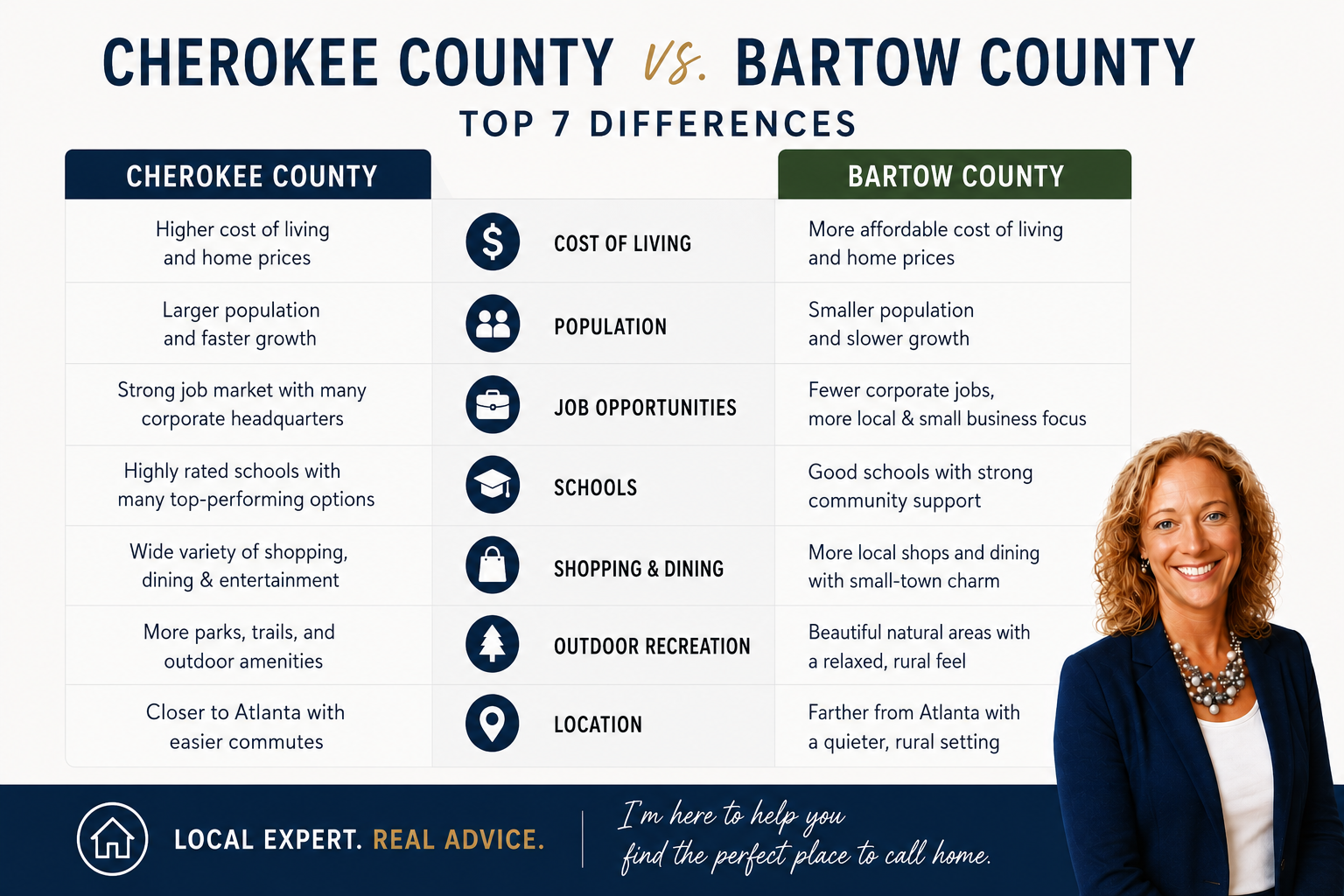
The median property value in Cherokee County, GA was $435,100 in 2024, up 11.6% from $389,800 in 2023. The median sale price in Bartow County was $332,000 in early 2025, up 2.3% year over year. That $100,000-plus price differential — for counties that share a border and both sit within 45 minutes of downtown Atlanta — is the headline comparison that sends most buyers to Cherokee County without ever seriously investigating what Bartow County offers. This post makes that case honestly, with the specifics both counties deserve.
Nicole France, REALTOR® with RE/MAX Center, serves buyers and sellers across both Cherokee County and Bartow County. She has worked the full Northwest Atlanta corridor for over 26 years and knows the specific community-level differences that county-level statistics don’t capture. Here are the seven differences that matter most.
1. Home Prices: A Consistent $100,000-Plus Gap
The home price comparison between Cherokee County and Bartow County is the most immediately visible and most financially significant difference for buyers who are cross-shopping the two markets. The median property value in Cherokee County was $435,100 in 2024, with Woodstock’s most sought-after communities — Eagle Watch, Towne Lake Hills, Bradshaw Farm — running meaningfully above that median. Bartow County’s median sale price was $332,000 in early 2025, with Cartersville’s established neighborhoods like The Planters and The Waterford running at or slightly above the county median.
At equivalent price points, Bartow County consistently delivers more square footage, more lot size, and in many cases newer construction than Cherokee County. A buyer at $400,000 in Bartow County is purchasing a four-bedroom home in an established neighborhood with access to cultural amenities that most comparable suburban markets don’t have at this price point. A buyer at $400,000 in Cherokee County is purchasing at the lower end of the Woodstock market — in communities like Wyngate or Brookshire rather than in the corridor’s most sought-after addresses.
The price gap reflects real differences in market recognition and development stage — not differences in the underlying quality of life available in both counties. Bartow County’s cultural infrastructure, outdoor access, and established community character are not priced at the same level as Cherokee County’s because the market has not yet fully recognized them. That gap between price and quality is where the Bartow County opportunity lives — and it is the specific opportunity that buyers who do their research before the broader market does consistently look back on as a decision that worked. Find out what your current home is worth before making the county decision.
2. Property Taxes: Bartow County’s Structural Advantage
The property tax comparison between Cherokee County and Bartow County is one of the most consequential financial differences in the decision — and one where Bartow County holds a meaningful structural advantage. The effective property tax rate in Cherokee County is 0.68% of market value. Bartow County’s effective rate runs modestly lower, producing annual tax bills that are meaningfully less than Cherokee County bills on comparable home values — a difference that becomes more significant as home values increase.
On a $400,000 home, the effective tax difference between Cherokee County and Bartow County produces an annual differential of $400 to $700, depending on the specific millage rates applied to the property. Over a 20-year ownership horizon, that differential accumulates to $8,000 to $14,000 in additional taxes paid in Cherokee County relative to a comparable Bartow County purchase. At higher price points — the $600,000 to $800,000 range where both counties have active luxury markets — the tax differential grows proportionally and becomes a more significant financial consideration.
Both counties offer senior property tax exemptions for qualifying older homeowners. Cherokee County offers a double homestead exemption for eligible older homeowners, reducing the assessed value by $5,000 for county taxes and $200,400 for school taxes. Bartow County has its own senior exemption structure with school tax relief for qualifying residents. For buyers 65 and older who are specifically planning for multi-decade retirement affordability, the exemption structure in each county is worth confirming directly with the county tax commissioner’s office before factoring it into a budget comparison. The county office is the authoritative source for current eligibility requirements and amounts, which can change.
3. School Districts: Cherokee’s Depth vs. Cartersville’s A-Rating
The school district comparison between Cherokee County and Bartow County is one of the most nuanced in the Northwest Atlanta corridor — because it is not a simple better-versus-worse comparison. It is a comparison between two meaningfully different school system types that serve different buyer profiles.
The Cherokee County School District is one of the largest and most consistently strong in Georgia, serving over 43,000 students across 35 schools with competitive academic performance, career and technical education programs, and graduation rates that outperform state averages. The district’s scale produces breadth — a wide range of specialized programs, magnet schools, and career academies — and the community recognition that has been built through decades of consistent performance. Cherokee County’s school district quality is a primary driver of the county’s strong buyer demand and sustained appreciation.
Cartersville City Schools — which serves homes within the Cartersville city limits — operates as a separate, independent system from the Bartow County School System and earns an A rating from Niche. For a city school district of Cartersville’s size, that performance is genuinely impressive and reflects the kind of community investment in education that produces results across multiple grade levels. The critical due diligence item: homes with a Cartersville mailing address in unincorporated Bartow County are served by the Bartow County School System rather than the Cartersville City system. Confirm the specific school assignment for any address through the appropriate school district’s enrollment office before making a county decision based on school expectations.
For buyers who are specifically targeting the Cartersville City Schools system, the home search needs to focus on properties within the Cartersville city limits — a geographic constraint that the listing address alone doesn’t always make clear. A local agent who knows the school district boundaries at the street level is essential for this specific buyer priority. Nicole France can confirm school assignments for any specific address in either county.
4. Commute to Atlanta: Cherokee’s Distance Advantage
Cherokee County’s proximity to Atlanta along I-575 gives it a commute advantage over Bartow County that is structural and durable. Woodstock, the primary market in Cherokee County, is approximately 35 miles north of downtown Atlanta via I-575 — producing off-peak commute times of 35 to 45 minutes to most Atlanta employment centers. The average commute time in Cherokee County was 31.3 minutes, reflecting a population that includes significant remote worker representation alongside traditional commuters.
Cartersville sits approximately 45 miles north of downtown Atlanta via I-75 — the additional 10 miles translating to 15 to 25 minutes of additional peak-hour commute time compared to Woodstock. Off-peak travel from Cartersville to the Cumberland business district runs approximately 40 to 50 minutes. Peak-hour commutes to Midtown or Buckhead can run 65 to 85 minutes depending on traffic conditions and departure time. That additional commute burden is real and daily for buyers who are traveling to Atlanta’s core on a fixed schedule.
The commute comparison changes significantly for buyers whose employer is located in the Northwest Atlanta corridor itself — Kennesaw, Acworth, Marietta — rather than in Atlanta proper. For those buyers, the commute from Cartersville to a Kennesaw or Acworth employer may be comparable to the commute from Woodstock, eliminating the Cherokee County commute advantage for their specific situation. And for buyers who work remotely — an increasingly common profile in both counties — the commute calculation becomes essentially irrelevant, shifting the county comparison entirely to home price, lifestyle, and school district factors where Bartow County’s advantages are most pronounced.
5. Cultural Infrastructure: Bartow County’s Genuine Surprise
The cultural infrastructure comparison between Cherokee County and Bartow County is the most counterintuitive element of this comparison — and the one that most consistently surprises buyers who haven’t visited Cartersville before making their county decision. Cherokee County’s cultural infrastructure is solid and growing — downtown Woodstock’s Main Street has excellent restaurants, live music at the Cherokee Amphitheater, and a genuine Entertainment District designation. Downtown Canton has its own revitalization underway with First Friday concerts and an expanding arts and dining corridor.
But Cartersville’s cultural infrastructure is genuinely exceptional for a city of its size — and it exceeds what Cherokee County’s cities offer at the institutional level. The Smithsonian-affiliated Booth Western Art Museum is the largest single-floor museum in the Southeast. The Tellus Science Museum draws school groups and families from across Georgia. The Savoy Automobile Museum is a world-class collection of American automobiles. The world’s first outdoor painted Coca-Cola wall sign is in downtown Cartersville. The Grand Theatre hosts live performances in a restored historic venue. The Etowah Indian Mounds State Historic Site is one of the most significant pre-Columbian archaeological sites in the Southeast.
This cultural depth — concentrated in a city of 23,000 — is the specific feature that Cartersville buyers consistently cite as the most unexpected quality of life advantage they discovered after moving. It is also the feature that most directly differentiates Bartow County from every other Northwest Atlanta county for buyers who specifically value cultural infrastructure as a daily life element rather than an occasional outing. Explore the communities Nicole serves in both Cherokee and Bartow counties here.
6. Outdoor Recreation: Both Counties Deliver — Differently
Outdoor recreation access is a primary quality-of-life factor for buyers in both counties, and the comparison is less about which county has more outdoor access and more about which county’s specific outdoor character fits a buyer’s lifestyle preferences.
Cherokee County’s outdoor infrastructure centers on Kennesaw Mountain National Battlefield Park’s 22-plus miles of interconnected trails accessible from Woodstock and the broader southern Cherokee County corridor, Olde Rope Mill Park’s 20-plus miles of mountain biking and hiking trails in Woodstock, the Noonday Creek Trail running through the Towne Lake corridor, and the Greenprints Trail System’s expanding multi-use path network connecting downtown Woodstock to surrounding neighborhoods. Lake Allatoona borders Cherokee County’s southern edge, providing boating and waterfront access within a 15 to 20-minute drive from most Woodstock addresses.
Bartow County’s outdoor infrastructure is anchored differently — by Red Top Mountain State Park directly on Lake Allatoona’s southern shoreline, with 15-plus miles of lake-view trails, a sand beach, camping, and cottages at I-75 Exit 285. The lake is not peripheral to Cartersville’s outdoor lifestyle — it is central to it, with multiple ramps and day-use areas within 10 to 15 minutes of most Cartersville residential addresses. The Pine Mountain Trail, Vineyard Mountain, Cooper’s Furnace Day Use Area on the Etowah River, the Allatoona Pass Battlefield, and the Etowah Indian Mounds all add outdoor variety that complements the lake access with trail, river, and archaeological dimensions that Cherokee County’s trail system doesn’t replicate.
For buyers who prioritize lake access specifically — boating, fishing, waterfront recreation — Bartow County’s proximity to Lake Allatoona gives it a genuine advantage over most Cherokee County addresses. For buyers who prioritize trail running and mountain biking — the Kennesaw Mountain and Olde Rope Mill type of trail experience — Cherokee County’s infrastructure leads. Both counties provide genuinely excellent outdoor access; the question is which type of outdoor access matters most to your daily routine.
7. Long-Term Appreciation: Cherokee’s Track Record vs. Bartow’s Opportunity
The appreciation comparison between Cherokee County and Bartow County reflects two counties at genuinely different stages of their market recognition cycles — and buyers who understand what that means are better positioned to evaluate the investment dimension of their purchase alongside the lifestyle dimension.
Cherokee County has a documented, sustained appreciation track record. Between 2023 and 2024, the median property value increased from $389,800 to $435,100, an 11.6% increase. The county has grown every year for 24 consecutive years and is projected to grow 53% between 2020 and 2050 — a population growth foundation that supports continued demand for well-located communities. Buyers who purchased in Woodstock’s Towne Lake corridor, Eagle Watch, and Bradshaw Farm a decade ago have seen consistent appreciation that reflects both the broader market and the specific narrative of buyers discovering Cherokee County’s quality-of-life value.
Bartow County’s appreciation story is more modest in recent history — Bartow County home prices were up 2.3% year over year in early 2025 — but the underlying fundamentals support a stronger long-term trajectory than that recent rate suggests. The county’s cultural infrastructure investment, its Lake Allatoona and Red Top Mountain outdoor access, its Cartersville City Schools’ A-rating, and its position as the most affordable county in the Northwest Atlanta corridor with genuine quality-of-life infrastructure all support continued buyer discovery that has historically driven appreciation in markets at this stage of their recognition cycle.
The investment framing that most accurately captures the Cherokee-Bartow comparison: Cherokee County offers proven appreciation in a fully recognized market. Bartow County offers the opportunity to buy into a market whose quality-of-life infrastructure is not yet fully reflected in its pricing. Buyers who are optimizing for stability and proven track record are better served in Cherokee County. Buyers who are optimizing for value relative to quality and are willing to buy ahead of broader market recognition are better positioned in Bartow County. Both are legitimate strategies — the right choice depends on your specific investment horizon and risk tolerance alongside your lifestyle priorities. Explore all of Nicole’s service areas across both counties on the areas we serve page. See what past buyers say at nicolefrance-realestate.com/testimonials.
Frequently Asked Questions: Cherokee County vs. Bartow County, Georgia
Is Cherokee County or Bartow County better for families?
Both counties offer genuinely strong family environments, but they serve different family profiles. Cherokee County’s advantage is its larger, more established school district with greater program variety, its stronger long-term appreciation track record, and its more active buyer market that supports resale liquidity. Bartow County’s advantage is its significantly lower home prices that allow families to get more space and a better-located home for the same budget, its Cartersville City Schools A-rating for families within city limits, and its cultural infrastructure — the Tellus Science Museum, the Booth Western Art Museum — that gives children access to world-class educational institutions without a long drive. The right county for your family depends on whether school district scale and recognition or home price value and cultural access are your primary priorities.
What is the median home price in Cherokee County vs. Bartow County?
The median property value in Cherokee County was $435,100 in 2024, up 11.6% from the prior year. Bartow County’s median sale price was $332,000 in early 2025, up 2.3% year over year. The approximately $100,000 gap between the two counties’ medians is consistent across price tiers — buyers at $400,000, $500,000, and $600,000 all find meaningfully more home per dollar in Bartow County than in comparable Cherokee County communities. Whether that price advantage is worth the commute difference and school district trade-offs depends on each buyer’s specific priorities.
Is Cartersville in Cherokee County or Bartow County?
Cartersville is in Bartow County. It is Bartow County’s largest city and county seat, located approximately 45 miles north of downtown Atlanta via I-75. Cartersville is adjacent to Cherokee County’s southern border but is entirely within Bartow County. Canton is the county seat of Cherokee County, located approximately 35 miles north of Atlanta via I-575. Woodstock is Cherokee County’s most active real estate market and the primary residential destination for buyers considering the county. Buyers who are cross-shopping Woodstock in Cherokee County against Cartersville in Bartow County should confirm that they are comparing the right geographic markets, as the two cities are in different counties with different tax structures, school districts, and commute profiles.
Ready to Choose Between Cherokee County and Bartow County?
Nicole France, REALTOR® with RE/MAX Center, has been helping buyers make the Cherokee County versus Bartow County decision for over 26 years. She knows the specific communities, school assignments, tax structures, commute profiles, and lifestyle characters of both counties in detail — and she can help you match your specific priorities to the county and community that actually fits how you live.
Schedule a complimentary and confidential consultation with Nicole France at (404) 867-3869 or visit nicolefrance-realestate.com to start the comparison before you schedule your first showing.
Nicole France is a REALTOR® with RE/MAX Center serving buyers and sellers across Acworth, Kennesaw, Dallas, Cartersville, and Woodstock. Client Focused · Results Driven.