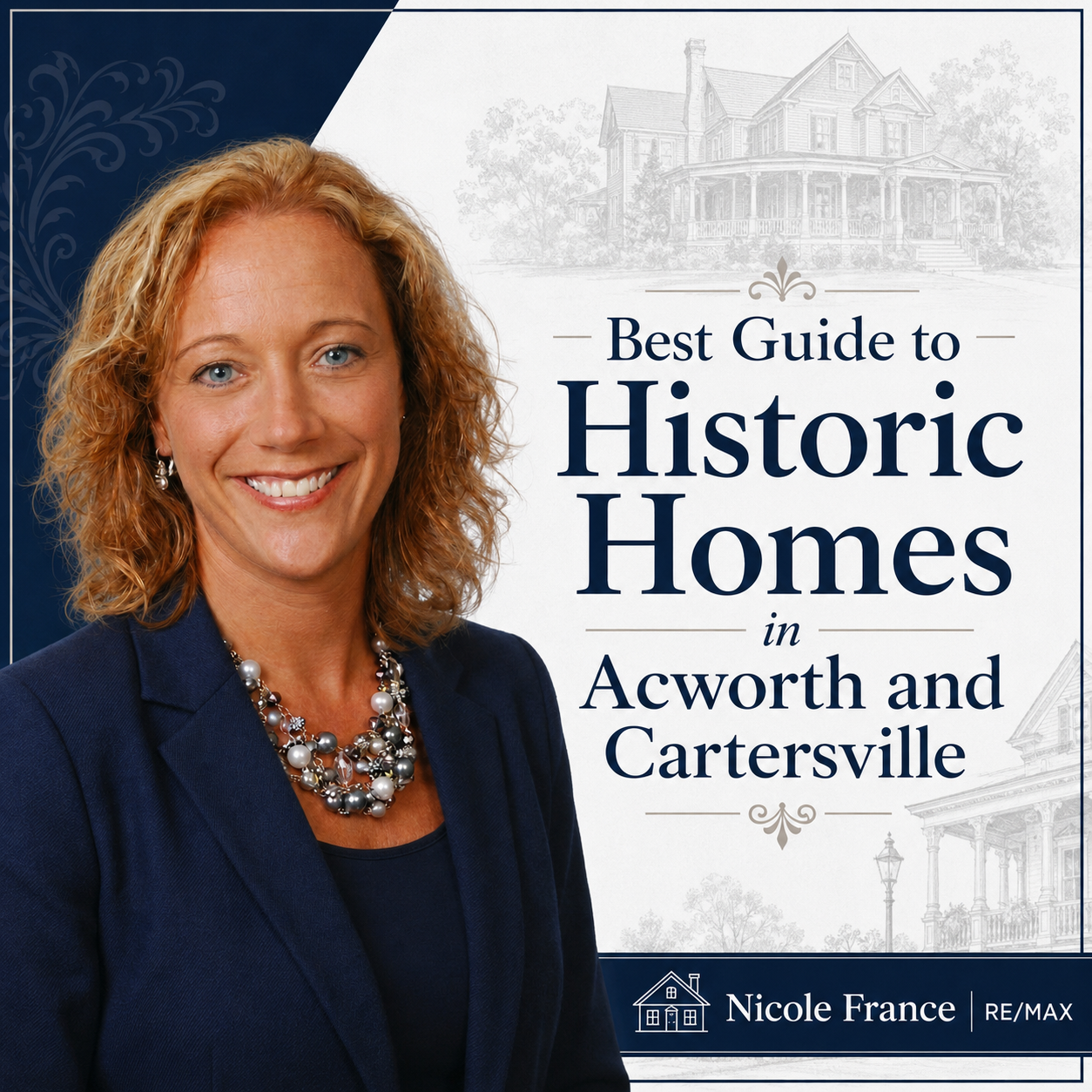
Falling for one of the historic homes in acworth or Cartersville is easy. A wrap-around porch, original heart-pine floors, a hundred years of character no builder can replicate. The house has a story, and standing on that porch you can feel yourself becoming part of it. What most buyers do not realize is that the charm comes with a rulebook, and the rulebook is written before you ever make an offer.
Here is the reframe. A historic home is not just an older house with nice trim. It is often a property inside a designated district, which means the porch you love, the windows you want to replace, and the paint color you have in mind may all be governed by a preservation commission. That is not a reason to walk away. It is a reason to understand what you are buying before you buy it, because the buyers who get blindsided are the ones who treated a historic home like any other listing.
Nicole France knows these downtowns and the homes inside them, from the Folk Victorian and Craftsman houses along Collins Avenue in Acworth to the residential districts surrounding downtown Cartersville. This post covers what district designation actually means, the inspection and insurance realities of older homes, how financing works, and what makes these properties worth the extra homework.
What Makes a Home Historic in the First Place
Historic is not just a feeling. It is often a formal designation with legal weight, and understanding the difference is the first step.
A property can be listed on the National Register of Historic Places individually, or it can sit inside a designated historic district. For National Register purposes, historic generally means 50 years old or older, with the property carrying genuine architectural or historical significance and integrity. A district is a concentration of historic buildings in their original setting, a whole neighborhood or downtown that tells a story together.
The key distinction for buyers is between National Register listing, which is largely honorary, and local historic district designation, which comes with real rules. A home can be both, one, or neither. Knowing which category a specific home falls into changes everything about what you can and cannot do to it.
The Historic Districts of Downtown Acworth
Acworth’s downtown is a genuine time capsule. The Acworth Downtown Historic District was added to the National Register of Historic Places in 2006, a linear district running along Main Street and the CSX railway tracks, covering roughly 14 acres with dozens of contributing buildings dating back as far as the 1840s.
The residential character lives largely in the Collins Avenue Historic District, once part of a large farm settled in the 1830s. The significant architectural styles there include Folk Victorian and Craftsman, spanning more than 80 years of residential development, from a central-hall house dating to around 1840 to a collection of 1928 Craftsman bungalows. These are the homes with the porches, the detailing, and the stories.
Acworth has embraced preservation deliberately, restoring landmarks like the Acworth Depot while designing new development to complement the existing architecture. That commitment is part of what protects the value of a historic home here, but it also signals that the city takes its historic character seriously, which matters when you own a piece of it.
The Historic Districts of Cartersville
Cartersville takes historic preservation even further, and buyers there need to pay close attention. The city has five locally designated historic districts: Cherokee-Cassville, the Downtown Business District, Granger Hill, Olde Town, and West End.
The West End Historic District is a standout for residential buyers, a bedrock of residential development from the 1870s to the 1920s. The architectural range is remarkable: Craftsman, Colonial Revival, Folk Victorian, Neoclassical Revival, English Vernacular Revival, Gothic Revival, and Prairie styles, with several homes dating from just after the Civil War. Downtown Cartersville itself, anchored by the often-filmed 1903 courthouse and the National Register commercial district listed in 2014, gives the whole area a preserved, walkable core.
Here is the critical part for buyers. Cartersville has an active Historic Preservation Commission, and it requires approval before certain projects. That includes replacing or relocating windows or doors with a change in material, adding new accessory buildings, demolishing or relocating a structure, and certain new fences. If you plan to renovate, this is not a formality you can skip.
Why District Designation Changes Your Buying Decision
This is the single most important thing to understand about historic homes in acworth and Cartersville. If a home sits in a locally designated district with a preservation commission, your renovation plans are subject to review.
What that means in practice: the improvements you assumed you could make, swapping windows, changing exterior materials, altering the facade, adding a structure, may require a certificate of approval before you begin. The commission’s job is to protect the district’s architectural integrity, which is exactly what preserves the home’s character and value. But it also means your timeline, your budget, and your design choices operate inside a framework you do not fully control.
This is not a reason to avoid these homes. It is a reason to confirm the exact designation of any specific property, understand the local commission’s rules, and factor them into your plans before you write an offer. A buyer who wants to gut and modernize a protected historic home is setting up a conflict. A buyer who wants to restore and preserve one is a perfect fit.
The Inspection Realities of an Older Home
Older homes are wonderful, and they are also older. The inspection on a historic property deserves more attention, not less, and often more specialized attention than a standard build.
Expect to encounter the issues that come with age: older electrical systems that may include outdated wiring, dated plumbing that could include materials no longer used, foundations that have settled over a century, and roofs, chimneys, and structural elements that have weathered decades. None of these are automatically deal-breakers. Many are exactly what you would expect and can be addressed. But you need to know about them going in.
For a historic home, consider an inspector experienced with older construction, and take the add-on inspections seriously. Given Georgia’s climate, evaluating for moisture, termite activity, and structural integrity matters even more in a home that has stood for a hundred years. Your due diligence period is where you gather all of this information, and on a historic home you want to use every day of it.
The Insurance Question Buyers Forget
Insuring a historic home is genuinely different from insuring a new build, and it catches buyers by surprise.
The reason is replacement cost. Historic homes often contain materials, craftsmanship, and architectural details that are expensive or difficult to replicate: original millwork, plaster, specific window styles, period detailing. If a portion of the home is damaged, restoring it to match may cost far more than rebuilding a standard structure, and your insurance needs to account for that.
Some insurers specialize in older and historic homes precisely because of this. Before you commit to a historic purchase, get a real insurance quote during your due diligence period, not after. An unexpectedly high premium, or difficulty finding coverage at all, is exactly the kind of thing that should factor into your decision while you still have the right to walk away. This is a conversation to have early, not a surprise to discover at closing.
Financing a Historic Home
Most historic homes finance with a standard mortgage, the same as any other resale property. But two wrinkles are worth understanding before you shop.
First, condition matters to lenders. If a historic home has significant deferred maintenance, some loan programs may flag issues that need addressing. A home in good, restored condition rarely presents a problem, while one that needs substantial work might steer you toward a renovation loan product.
Second, renovation financing exists for exactly this situation. If you are buying a historic home that needs restoration, certain loan programs bundle the purchase price and the renovation cost into a single mortgage. That can be a powerful tool for a fixer-upper in a historic district, though the preservation commission’s approval requirements still apply to whatever work you plan. Talk to a lender experienced with older homes and renovation products before you assume how you will finance it. Nicole France is a REALTOR®, not a lender, so loan specifics come from your mortgage professional.
What These Homes Give You in Return
The homework is real, so it is worth remembering what you get for it. Historic homes offer something new construction simply cannot: authenticity, craftsmanship, and a location in the heart of a walkable, storied downtown.
In Acworth, that means living steps from the restaurants, festivals, and lake access that make the downtown a destination. In Cartersville, it means proximity to a preserved courthouse square, museums, and one of the most intact historic downtowns in the region. These are not just houses. They are homes inside communities that have chosen to protect what makes them special.
There is also a value argument. Historic districts, by preventing incompatible development and preserving character, tend to protect the long-term desirability of the area. The same rules that constrain your renovation also protect your neighbor from doing something that would harm your home’s value. That trade cuts both ways, and for the right buyer it cuts in their favor.
Questions to Ask Before You Make an Offer
Before you fall all the way in love, get clear answers to a specific set of questions. Each one can change your decision or your budget.
- Is this specific property in a locally designated historic district, a National Register district, both, or neither?
- If it is locally designated, what does the preservation commission require approval for, and does that affect my renovation plans?
- What is the true condition of the electrical, plumbing, roof, and foundation, confirmed by an inspector experienced with older homes?
- What will it actually cost to insure, quoted during due diligence?
- If I need renovation financing, what programs fit, and how do the commission’s rules interact with them?
Answer these before you write, not after, and a historic home becomes a confident purchase instead of a gamble.
What Buyers Need to Know
A historic home in Acworth or Cartersville is one of the most rewarding purchases in Northwest Atlanta, and one of the most detail-dependent. The charm is real, and so is the rulebook. The buyers who thrive are the ones who confirm a property’s exact designation, understand what the local preservation commission controls, inspect thoroughly with an eye for age, and quote insurance and financing before they commit.
The mistake is treating a historic home like any other listing and discovering the constraints after closing. Do the homework during due diligence, when you still have every option open, and you get the porch, the floors, the story, and the peace of mind. Skip it, and the same features that made you fall in love can become the source of your first regret.
Historic district rules, preservation requirements, insurance, and financing all vary by property and by city, and this post is general education rather than advice on any specific home. Confirm designation and requirements directly with the city, and consult a lender and insurance professional for your situation. Nicole France is a REALTOR®, not an attorney, a lender, or an insurance agent.
Frequently Asked Questions
Can I renovate a historic home however I want?
It depends on the designation. If the home is in a locally designated historic district with a preservation commission, certain exterior projects may require approval before you begin, such as changing window or door materials, adding structures, or altering the facade. Cartersville, for example, requires commission approval for several types of exterior work. A home that is only on the National Register, or not designated at all, generally has more flexibility. Confirm the exact designation of any specific property before assuming what you can do.
Are historic homes harder to insure?
They can be more expensive to insure because of replacement cost. Original materials, craftsmanship, and architectural details are often costly to replicate if damaged, so premiums may run higher than a comparable new build. Some insurers specialize in older and historic homes for exactly this reason. Get a real insurance quote during your due diligence period so any surprise is one you can act on while you still have the option to walk away.
Is it harder to get a mortgage on a historic home?
Usually not, if the home is in good condition. Most historic homes finance with a standard mortgage. The wrinkle is condition: significant deferred maintenance can complicate some loan programs, and a fixer-upper in a historic district might be better suited to a renovation loan that bundles purchase and repair costs. Talk to a lender experienced with older homes and renovation products before you shop, so you know your options going in.
Buy the Story With Your Eyes Open
A historic home should be a joy, not a surprise. Knowing the districts, the rules, and the realities before you make an offer is what turns a beautiful old house into the right decision.
Nicole France knows the historic corridors of Acworth and Cartersville, the questions to ask, and how to structure your due diligence so nothing catches you off guard. Whether you want to restore a Folk Victorian or settle into a Craftsman bungalow, the homework comes first. Learn more about Nicole or reach out directly.
(404) 867-3869 | nicolefrance-realestate.com/contact/
Nicole France is a REALTOR® with RE/MAX Center serving buyers and sellers across Acworth, Kennesaw, Dallas, Cartersville, and Woodstock. Client Focused · Results Driven.