
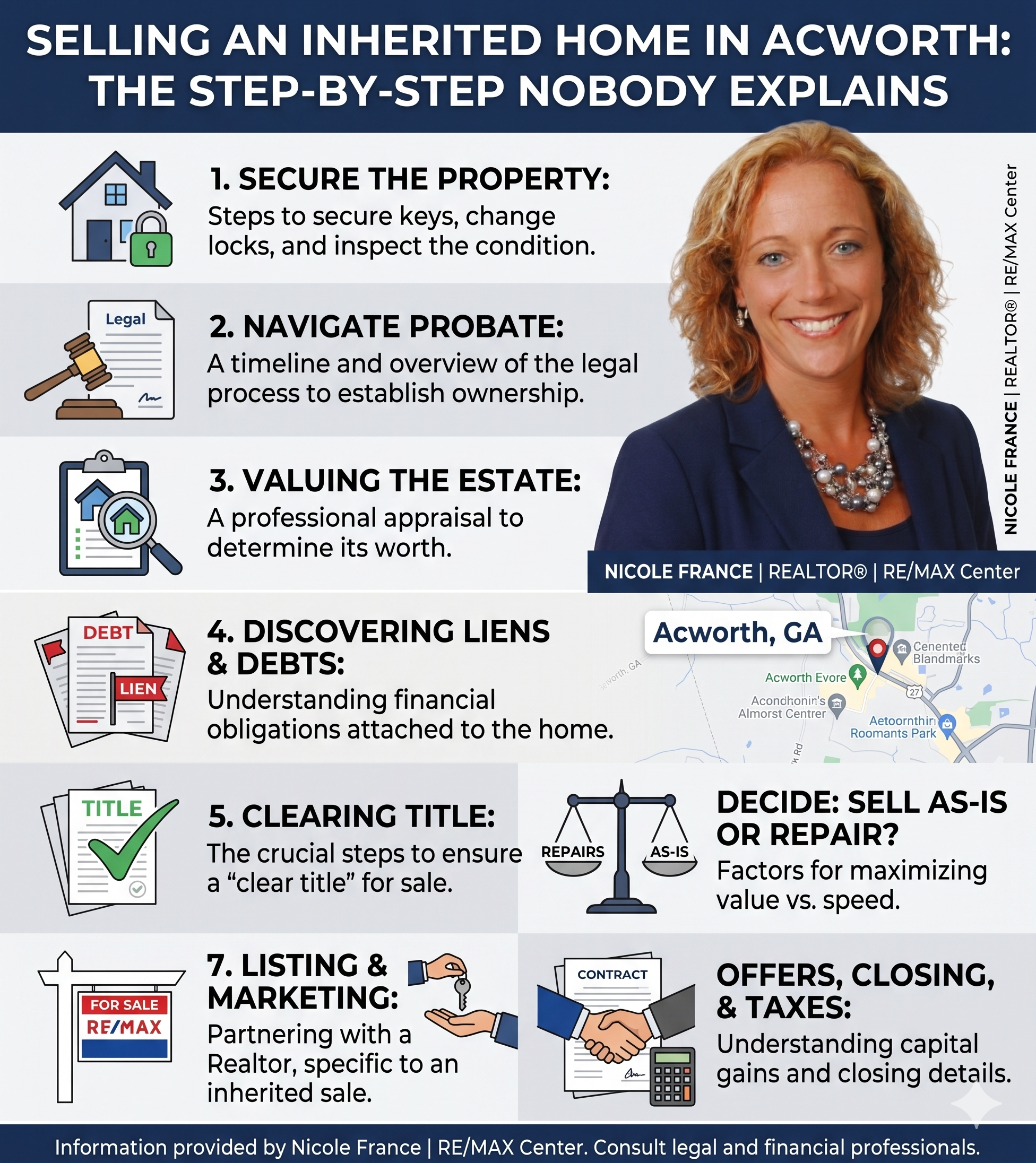
How do you sell an inherited home in Acworth or Cobb County, Georgia?
Short answer: Selling an inherited home in Acworth usually requires going through the Cobb County Probate Court first, then working with an experienced real estate agent to price, prep, and market the home. The full process often takes 8 to 12 months. The good news: thanks to a federal tax rule called “step-up in basis,” most heirs pay little to no capital gains tax when the home is sold close to the date it was inherited.
If you have recently lost a parent, grandparent, or other loved one and now you are staring at a home full of memories, decades of belongings, and a mountain of legal paperwork — I am so sorry. I have walked many families through this exact situation over my 25+ years in Northwest Atlanta real estate. It is overwhelming, it is emotional, and most people do not know where to start.
Here is the honest, step-by-step roadmap I wish every family had before they began.
A Quick Note Before We Start
This blog is a general guide, not legal or tax advice. Every estate is different. Before you make any major decisions, you should consult with a Georgia-licensed probate attorney and a tax professional who knows Cobb County. The Cobb County Probate Court even offers free 30-minute appointments with volunteer attorneys and low-cost probate clinics for residents. Those resources exist for good reason — use them.
With that said, here is what the process typically looks like.
Step 1: Find the Will and the Deed
This sounds simple. It often is not.
Per Cobb County probate attorneys, you need the original Last Will and Testament, not a photocopy. Georgia courts generally assume that if the original cannot be located, the decedent intended to revoke the will. A photocopy can sometimes be admitted, but it adds time, legal expense, and complication.
While you are searching, also locate:
The property deed (this tells you how the home is titled)
The mortgage statement, if any
Most recent property tax bills (you will get two if the home is inside Acworth city limits)
Homeowner’s insurance policy
HOA documents, if applicable
Any recent appraisals or refinance paperwork
Pro tip from experience: check safe deposit boxes, fireproof safes, attorney’s offices the person may have worked with, and the back of dresser drawers. Important documents end up in the strangest places.
Step 2: Understand How the Home Was Titled
This one detail changes almost everything.
If the home was held in a revocable living trust: You may be able to skip probate entirely. The successor trustee can typically sell the property following the trust’s instructions.
If the home was held in joint tenancy with rights of survivorship: The surviving owner usually becomes the sole owner automatically. Probate may not be required for the home itself.
If the home was held only in the deceased person’s name: You will almost certainly need to go through the Cobb County Probate Court before the home can be sold.
A probate attorney can usually tell you within a single consultation which path applies to your situation.
Step 3: File With the Cobb County Probate Court
The Cobb County Probate Court is located at 32 Waddell Street in Marietta. Their staff cannot give legal advice, but they can point you toward resources, forms, and the Cobb Probate Information Session — a free virtual workshop that walks you through the basics.
At a high level, the probate process in Georgia includes:
Filing the petition with the Probate Court (either to probate the will, or for letters of administration if there is no will)
Notifying heirs and beneficiaries per Georgia law
Publishing notice to creditors, who then have 90 days to make claims against the estate
The estate being held open for at least three months after the creditor notice is published, so creditors have time to file
Inventorying and valuing the estate’s assets, sometimes with third-party appraisals
Paying legitimate debts from the estate before heirs receive their inheritance
Distributing remaining assets according to the will (or Georgia intestacy law if there is no will)
In total, a Georgia probate can take 8 months to a year — sometimes longer if the estate is complex or heirs disagree.
Step 4: Know Your Authority to Sell
This is one of the most misunderstood parts of the process.
Per Georgia law, whether an executor can sell the home without additional court approval depends on the language of the will:
If the will specifically grants the executor power to sell real estate, the executor can typically list and sell once Letters Testamentary are issued.
If the will is silent or restrictive, the executor usually must file a petition with the probate court explaining why the sale is necessary — to pay debts, to divide proceeds among heirs, etc. — and wait for court approval.
If there is no will, an administrator is appointed and generally must petition the court before selling real property.
In plain English: do not list the home, accept an offer, or sign a contract until you are certain you have legal authority to do so. Getting this wrong can invalidate a sale and create serious liability. A good probate attorney will confirm your authority in writing before you move forward.
Step 5: Understand the “Step-Up in Basis” Tax Rule (This Is a Big One)
This is the single most important piece of good news for most families selling an inherited home.
Under Internal Revenue Code Section 1014, when you inherit a home, your cost basis is generally “stepped up” to the fair market value of the home on the date of the original owner’s death — not what the decedent originally paid for it.
Why does this matter? An example:
Mom bought the Acworth home in 1992 for $110,000
When Mom passed away in 2026, the home was worth $475,000
You inherit the home. Your tax cost basis is now $475,000, not $110,000
You sell the home six months later for $480,000
You are generally only taxed on the $5,000 gain since you inherited it — not the $370,000 of appreciation that happened during Mom’s lifetime
For most heirs, selling an inherited home near the date of inheritance results in very little or even zero federal capital gains tax. That is a massive difference from selling a home you have owned for years.
Important: You need to document the fair market value as of the date of death. This is typically done with a formal appraisal or a professional Broker Price Opinion (BPO) from an experienced agent. Do not skip this step — the IRS can require documentation if they question your basis. Always verify how this rule applies to your specific situation with a tax professional.
Step 6: Get a Real, Honest Value
Grieving families often have two competing impulses: “this home is worth a fortune” or “let’s just take any offer and be done with it.”
Neither is usually right.
A good real estate agent with probate experience will give you:
A current, data-driven market value based on real comparable sales
An honest assessment of condition and what it would cost to prep the home for sale
A net proceeds estimate after closing costs, any repairs, and commission
A comparison of selling “as-is” vs. making strategic improvements first
Realistic timelines for the market you are actually in
Beware of cash-offer companies that quote you a price before even seeing the home. Those offers are usually well below market. Sometimes a fast “as-is” sale makes sense — especially if heirs live out of state, if the home needs major repairs, or if carrying costs are eating up the estate. But you deserve to know the full picture before you choose.
Step 7: Decide — Sell “As-Is” or Prep the Home?
Every inherited home is different. Some of the factors I walk families through:
Selling as-is makes sense when:
The home needs significant repairs the estate cannot afford to make
Heirs live far away and cannot manage contractors
The emotional toll of clearing out the home is too high
Multiple heirs want a fast resolution
The home’s layout or style is dated in a way updating cannot easily fix
Prepping the home first usually pays off when:
The home needs only cosmetic updates (paint, flooring, light fixtures)
Deep cleaning and decluttering will dramatically improve showings
A fresh coat of paint and a landscaped yard can add meaningful value
The Acworth market is active for well-prepared homes in that price range
A good agent will run the actual numbers. Sometimes $5,000 in smart prep returns $25,000 in sale price. Sometimes it does not. This is exactly the kind of math you want a 25-year veteran running for you, not guessing at yourself.
Step 8: Clear Out the Home (The Emotional Step Nobody Prepares You For)
This is often the hardest part — and it has nothing to do with real estate.
A few practical tips that help families:
Give yourself time. You do not have to clear the home in a weekend.
Sort into categories: keep, give to family, donate, sell, discard.
Photograph items before letting them go. Memories live in photos too.
Consider an estate sale company for valuable items and clean-outs.
Do not throw away paperwork until the estate is closed. Tax documents, medical records, and financial statements may still be needed.
Lean on family. Dividing the work lightens the weight.
I have seen families rush this step and regret it. I have also seen families get stuck here for years. Somewhere in the middle is the right pace for you.
Step 9: List, Market, and Close
Once the home is ready and you have legal authority to sell, the selling process is largely the same as any other Georgia home sale — with a few extra wrinkles:
Disclosures are still required, even though the executor never lived in the home
Buyers may ask more questions about the home’s history
Title work can take slightly longer on estate sales
If the sale required court approval, there may be additional filings after closing
Proceeds from the sale typically go into the estate account, not directly to heirs, until the estate is properly settled. Your probate attorney will walk you through the final distribution.
How to Shop Smart for the Right Agent
When you are interviewing agents to sell an inherited home in Acworth, ask:
How many inherited or estate home sales have you handled?
Do you have a probate attorney you regularly coordinate with?
Will you provide a written Broker Price Opinion for the date of death?
What is your strategy for homes that may need some updates?
Will I work directly with you, or will I be passed to an assistant?
That last one matters more than people realize. Selling an inherited home is emotional, time-sensitive, and full of moving parts. You deserve direct access to an experienced agent — not a junior team member.
The Bottom Line
Selling an inherited home in Acworth is not fast, and it is not simple — but it is absolutely doable with the right guidance. With a probate attorney on the legal side and an experienced agent on the real estate side, you can move through this process with far less stress than most families expect.
You do not have to figure it out alone. If you are walking through an inherited home right now and you do not know where to start, I would be honored to help you think through your options — no pressure, no sales pitch. Just a clear conversation about what you are facing and what path might make the most sense for your family.
Going Through an Inherited Home Sale? Let’s Talk.
With 25+ years of experience in Northwest Atlanta real estate, I have helped many families navigate the sale of inherited and estate homes with patience, honesty, and straightforward guidance. As a solo agent at RE/MAX Center, you work directly with me from our first conversation through closing — no handoffs, no hurry.
Call Nicole France at (404) 867-3869 for a personal, no-pressure consultation about your inherited home.
📧 NicoleFrance@REMAX.net
🌐 nicolefrance-realestate.com
Nicole France | Realtor | RE/MAX Center | Serving Acworth and Northwest Atlanta
This blog is for general informational purposes only and is not legal or tax advice. Please consult a Georgia-licensed probate attorney and a qualified tax professional for guidance specific to your situation.